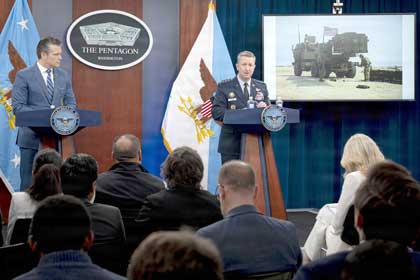
 Secretary of War Pete Hegseth, left, and Air Force Gen. Dan Caine, chairman of the Joint Chiefs of Staff, hold a press briefing at the Pentagon, April 8, 2026, to discuss the ceasefire between the U.S. and Iran. Photo credit: Benjamin Applebaum, DOW
Epic Fury quelled for now, objectives accomplished, U.S. forces remain ready
by C. Todd Lopez, Pentagon News
April 8, 2026 -- In fewer than 40 days, unrelenting military action by America's joint force has helped accomplish all the goals President Donald J. Trump set for Operation Epic Fury.
Last night, Iranian leaders agreed to a ceasefire and to working with the president on a way ahead that includes, among other things, opening the Strait of Hormuz and abandoning Iran's pursuit of nuclear weapons.
In a statement by the Iranian minister of foreign affairs, Iran agreed to negotiations with the U.S., a ceasefire and allowing two weeks of safe passage for ships through the strait.
On social media, the president said it was a "big day for world peace" and predicted a positive outcome for Iran and its neighbors. "Just like we are experiencing in the U.S., this could be the golden age of the Middle East."
The United States kicked off combat operations against Iran on Feb. 28, as part of Operation Epic Fury, with the goal of destroying Iran's offensive missiles, missile production, the Iranian navy and other security infrastructure — ensuring Iran never has nuclear weapons. Those goals have been accomplished.
"Together with our Israeli partners, America's military achieved every single objective on plan, on schedule, exactly as laid out from day one," Secretary of War Pete Hegseth said during a press briefing this morning at the Pentagon. "Iran's navy is at the bottom of the sea. ... Iran's air force has been wiped out. Iran no longer has ... any sort of a comprehensive air defense system; we own their skies. Their missile program is functionally destroyed: launchers, production facilities and existing stockpiles depleted and decimated."
Last night, Hegseth said, in more than 800 strikes in Iran, the U.S. completed the destruction of Iran's defense industrial base, meaning it will take decades for the Iranians to rebuild what was taken from them by America's joint force.
"We finished completely destroying Iran's defense industrial base, a core pillar of our mission objective," Hegseth said. "They can no longer build missiles, build rockets, build launchers or build [unmanned aircraft systems]. Their factories have been razed to the ground, set back in historic fashion."
Over the course of 38 days of combat operations, said Air Force Gen. Dan Caine, chairman of the Joint Chiefs of Staff, the American joint force struck more than 13,000 targets, including 4,000 dynamic targets that materialize once aircraft are already in the air.
"[U.S. Central Command] forces destroyed approximately 80% of Iran's air defense systems, striking more than 1,500 air defense targets, more than 450 ballistic missile storage facilities, 800 one-way attack drones storage facilities — all of these systems are gone," Caine said. "We've devastated Iran's command and control and logistical networks, destroying more than 2,000 command and control nodes and degrading their ability to target U.S. and friendly forces."
Assessments indicate the joint force has sunk more than 90% of the regular Iranian fleet — 150 ships are at the bottom of the ocean, he said, as well as half of the Islamic Revolutionary Guard Corps navy's small attack boats.
As a warrior himself, Caine sympathized with the Iranian commanders.
"It is, and we know this, incredibly frustrating right now to be a lower-level Iranian commander trying to fight your fight," he said.
Most important, Caine said, is that Iran's defense industrial base has been destroyed.
"We attacked, along with our partners, approximately 90% of their weapons factories," he said. "Every factory that produced Shahed one-way attack drones was struck; every factory that produces the guidance systems to go into those drones was struck. Their missile defense industrial base is shattered, with more than 80% of their missile facilities gone, as well as their solid rocket motor production capability."
With the destruction of more than 20 naval production facilities, Caine said, it will take Iran years to rebuild its surface fleet. And with 80% of its nuclear industrial base also hit, its ability to attain a nuclear weapon is also significantly degraded.
While Iran has agreed to a ceasefire, to reopen the Strait of Hormuz and to sit down for negotiations with the United States, the U.S military remains in theater and on watch, he said.
"A ceasefire is a pause, and the joint force remains ready, if ordered or called upon, to resume combat operations with the same speed and precision as we've demonstrated over the last 38 days — and we hope that is not the case," Caine said.
The secretary said the conditions have been set by the joint force, and that now is the time for a deal to be reached.
"Now we have a chance at real peace and a real deal," he said. "The War Department, for now ... has done its part. We stand ready in the background to ensure Iran upholds every reasonable term. And as everyone knows, nobody makes a better deal than President Trump. To the warriors of Epic Fury, I say, 'Well done.' You're the backbone of our country. Your skill, your bravery and sheer guts and grit showed the world what America is all about. I'm proud of you; we're proud of you; the president is proud of you. Job well done."
Military News | Navy News | Epic Fury quelled for now